
Gen‑1 (IRNSS‑1)
- Orbit
- 3× GEO + 4× IGSO (29–31° incl.)
- Signals
- L5 (1176.45 MHz) · S band (~2492 MHz)
- Clock
- Imported rubidium (SpectraTime); 3 per satellite planned
- Launches
- PSLV‑XL · 2013–2018 (1H failed)
- Design life
- 10‑year design
IRNSS · Programme history & context
Why India built a regional navigation constellation, how the spacecraft were launched, what went wrong in orbit, and where to learn how GNSS works or read today's broadcast health.
Official PNT service needs at least four healthy navigation satellites. After IRNSS‑1F’s last clock failed (Mar 2026), only three count for PNT today: IRNSS‑1B, IRNSS‑1I, and NVS‑01 (one short of a NavIC‑only fix). On 2 Jul 2025, an RTI thread on X (indianspaceflight.in · solidbosters2) had listed four PNT spacecraft including 1F with one clock; that snapshot predates 1F’s final failure. NVS‑02 is excluded after its propulsion anomaly. NVS‑03 launched 30 Oct 2026 but was not yet commissioned for PNT while orbit‑raising continued. Our status dashboard uses the latest IGS merged navigation file for day‑to‑day broadcast health, not ISRO commissioning bulletins. Open status →
NavIC needs at least four satellites for a standalone fix. IRNSS‑1F no longer contributes: all three rubidium clocks have failed. RTI reporting on 2 Jul 2025 (solidbosters2) described the fleet when 1F still had one clock; parliamentary answers echoed the wider Gen‑1 clock‑loss pattern.
Disclosed 2 Jul 2025 · solidbosters2 (founder, indianspaceflight.in): summarized from an RTI response on X. Thread on X →
| Satellite | Launch | RAFS working | PNT | Notes |
|---|---|---|---|---|
| IRNSS-1A | Jul 2013 | 0 / 3 | no | All RAFS failed; messaging / legacy payload. |
| IRNSS-1B | Apr 2014 | PNT active | yes | Operational PNT (2026 reporting). |
| IRNSS-1C | Oct 2014 | 0 / 3 | no | All clocks failed; messaging. |
| IRNSS-1D | Mar 2015 | 0 / 3 | no | All clocks failed; later decommissioned. |
| IRNSS-1E | Jan 2016 | 0 / 3 | no | All clocks failed; messaging. |
| IRNSS-1F | Mar 2016 | 0 / 3 | no | All RAFS failed; last clock Mar 2026. RTI Jul 2025 had reported 1 / 3. |
| IRNSS-1G | Apr 2016 | 0 / 3 | no | All clocks failed; slot replaced by NVS‑01. |
| IRNSS-1H | Aug 2017 | n/a | launch failed | PSLV fairing failure. |
| IRNSS-1I | Apr 2018 | PNT active | yes | Replacement for 1A; RTI Jul 2025 PNT list. |
| NVS-01 | May 2023 | 4 (1 × iRAFS + 3 imported) | yes | Gen‑2; iRAFS driving navigation signals since Jul 2023. |
| NVS-02 | Jan 2025 | 4 (1 × iRAFS + 3 imported) | no | Not used for PNT, orbit‑raise propulsion fault. |
| NVS-03 | Oct 2026 | 4 (1 × iRAFS + 3 imported) | commissioning | Orbit raise to IGSO; not yet PNT operational. |
Jul 2013 · RAFS 0 / 3
All RAFS failed; messaging / legacy payload.
Apr 2014 · RAFS PNT active
Operational PNT (2026 reporting).
Oct 2014 · RAFS 0 / 3
All clocks failed; messaging.
Mar 2015 · RAFS 0 / 3
All clocks failed; later decommissioned.
Jan 2016 · RAFS 0 / 3
All clocks failed; messaging.
Mar 2016 · RAFS 0 / 3
All RAFS failed; last clock Mar 2026. RTI Jul 2025 had reported 1 / 3.
Apr 2016 · RAFS 0 / 3
All clocks failed; slot replaced by NVS‑01.
Aug 2017 · RAFS n/a
PSLV fairing failure.
Apr 2018 · RAFS PNT active
Replacement for 1A; RTI Jul 2025 PNT list.
May 2023 · RAFS 4 (1 × iRAFS + 3 imported)
Gen‑2; iRAFS driving navigation signals since Jul 2023.
Jan 2025 · RAFS 4 (1 × iRAFS + 3 imported)
Not used for PNT, orbit‑raise propulsion fault.
Oct 2026 · RAFS 4 (1 × iRAFS + 3 imported)
Orbit raise to IGSO; not yet PNT operational.
Clock hardware and how iRAFS fits Gen‑2: RAFS page →
During the 1999 Kargil conflict, Indian forces could not obtain GPS data for the theatre from the United States. Pilots reportedly used commercial GPS units to improve targeting, a dependency India did not want to repeat in a crisis.
NavIC (Navigation with Indian Constellation, formerly IRNSS) is ISRO’s autonomous regional system for position, velocity, and timing over India and about 1,500 km beyond the borders, with studies for extension toward 3,000 km.
The Union Cabinet approved the programme in May 2006. The design goal was Indian control of space, ground, and user segments, with seven satellites in geostationary and inclined geosynchronous slots so four or more stay visible over India.
NavIC offers Standard Position Service (SPS) open to civilians (interoperable with other GNSS where L1 is enabled on Gen‑2) and Restricted Service (RS) on encrypted channels for authorised users including the military.
Not every launch failed, PSLV placed the Gen‑1 string successfully. Operational and clock failures still shaped the usable constellation.
2 Jul 2025
RTI: four PNT satellites, zero clock margin (snapshot)
An RTI response summarized on X by indianspaceflight.in founder solidbosters2 (2 Jul 2025) warned NavIC was at the four‑satellite edge: IRNSS‑1B, IRNSS‑1F (1 of 3 clocks), IRNSS‑1I, and NVS‑01. IRNSS‑1F is not counted for PNT on this page today: all three RAFS failed (last clock Mar 2026). Only IRNSS‑1B, IRNSS‑1I, and NVS‑01 remain for navigation. Later parliamentary answers and press reporting described the same Gen‑1 clock‑loss pattern.
2016–2018
Imported rubidium clocks failed across IRNSS‑1A and others
SpectraTime clocks on IRNSS‑1A failed (2016), mirroring early Galileo clock issues. Multiple failures across the fleet followed; by 2018 nine of 24 orbiting clocks had failed per press reports. ISRO later ran some satellites on a single clock to preserve life.
31 Aug 2017
PSLV‑C39 / IRNSS‑1H launch failure
The payload fairing did not separate on the fourth stage; IRNSS‑1H never reached the intended orbit. The spacecraft was meant to replace clock‑failed IRNSS‑1A.
2018–2026
Partial‑service satellites & decommissioning
Several Gen‑1 birds lost all navigation clocks but remain useful for one‑way messaging (1A, 1C, 1E, 1F, 1G per parliamentary and ISRO reporting). IRNSS‑1D was decommissioned after its clocks failed.
29 Jan 2025
NVS‑02 propulsion anomaly
GSLV‑F15 placed NVS‑02 in space, but orbit‑raising was disrupted by a valve malfunction. It is not operational for PNT, ISRO has looked at alternate uses; it did not replace IRNSS‑1E for navigation service.
2023–2027
Gen‑2 cadence & indigenous clocks
NVS series needs GSLV and Indian Rubidium Atomic Frequency Standard (iRAFS) maturation. NVS‑04/05 and further slots were reported delayed by clock procurement and qualification. ISRO has discussed up to five clocks per future satellite after repeated failures.
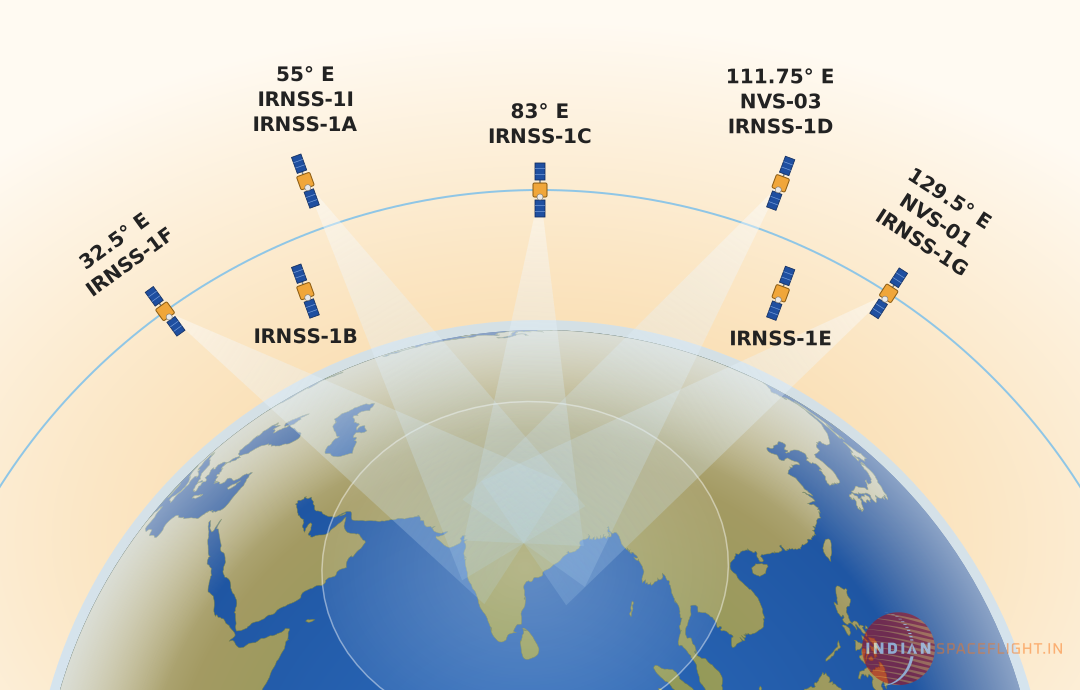
Summarized from ISRO releases and open reporting. Live broadcast state: constellation page.
| Satellite | PRN | PNT | Notes |
|---|---|---|---|
| IRNSS-1A | I01 | no | Clocks failed; messaging / legacy payload use. |
| IRNSS-1B | I02 | yes | Among satellites publicly cited for PNT in 2025–26 reporting. |
| IRNSS-1C | I03 | no | Clock failure; messaging service. |
| IRNSS-1D | I04 | no | Decommissioned after service life. |
| IRNSS-1E | I05 | no | Clock failure; messaging; NVS‑02 was intended replacement. |
| IRNSS-1F | I06 | no | All three RAFS failed (last clock stopped Mar 2026); messaging only. Jul 2025 RTI had counted it with one clock left. |
| IRNSS-1G | I07 | no | Superseded by NVS‑01 at 129.5°E; messaging. |
| IRNSS-1H | n/a | no | Launch failed, fairing on PSLV‑C39. |
| IRNSS-1I | I09 | yes | Replacement for 1A; operational PNT in 2026 reporting. |
| NVS-01 | I10 | yes | L1+L5+S; iRAFS; replaced 1G. |
| NVS-02 | n/a | no | Not in PNT service, propulsion fault during orbit raise (29 Jan 2025). |
| NVS-03 | TBD | commissioning | GSLV‑F18 (30 Oct 2026). Not commissioned for PNT yet, still in orbit‑raising to ~111.75°E IGSO slot. |
| NVS-04 / 05 | n/a | planned | Reported GSLV launches to restore four‑sat PNT margin. |
PRN I01
Clocks failed; messaging / legacy payload use.
PRN I02
Among satellites publicly cited for PNT in 2025–26 reporting.
PRN I03
Clock failure; messaging service.
PRN I04
Decommissioned after service life.
PRN I05
Clock failure; messaging; NVS‑02 was intended replacement.
PRN I06
All three RAFS failed (last clock stopped Mar 2026); messaging only. Jul 2025 RTI had counted it with one clock left.
PRN I07
Superseded by NVS‑01 at 129.5°E; messaging.
PRN n/a
Launch failed, fairing on PSLV‑C39.
PRN I09
Replacement for 1A; operational PNT in 2026 reporting.
PRN I10
L1+L5+S; iRAFS; replaced 1G.
PRN n/a
Not in PNT service, propulsion fault during orbit raise (29 Jan 2025).
PRN TBD
GSLV‑F18 (30 Oct 2026). Not commissioned for PNT yet, still in orbit‑raising to ~111.75°E IGSO slot.
PRN n/a
Reported GSLV launches to restore four‑sat PNT margin.
| Satellite | Date (IST, UTC in data) | Rocket | Outcome | Notes |
|---|---|---|---|---|
| IRNSS-1A | 1 Jul 2013 | PSLV-XL-C22 | orbit | IGSO 55°E · clocks later failed |
| IRNSS-1B | 4 Apr 2014 | PSLV-XL-C24 | orbit | IGSO 55°E |
| IRNSS-1C | 16 Oct 2014 | PSLV-XL-C26 | orbit | GEO 83°E |
| IRNSS-1D | 28 Mar 2015 | PSLV-XL-C27 | orbit | IGSO 111.75°E · later decommissioned |
| IRNSS-1E | 20 Jan 2016 | PSLV-XL-C31 | orbit | IGSO 111.75°E |
| IRNSS-1F | 10 Mar 2016 | PSLV-XL-C32 | orbit | GEO 32.5°E |
| IRNSS-1G | 28 Apr 2016 | PSLV-XL-C33 | orbit | GEO 129.5°E |
| IRNSS-1H | 31 Aug 2017 | PSLV-XL-C39 | launch failed | Fairing separation failure |
| IRNSS-1I | 12 Apr 2018 | PSLV-XL-C41 | orbit | Replacement for 1A |
| NVS-01 | 29 May 2023 | GSLV Mk II-F12 | orbit | GEO 129.5°E · Gen‑2 |
| NVS-02 | 29 Jan 2025 | GSLV Mk II-F15 | orbit degraded | Orbit raise fault · not in PNT service |
| NVS-03 | 30 Oct 2026 | GSLV Mk II-F18 | orbit | IGSO 111.75°E · commissioning / orbit raise, not yet PNT operational |
1 Jul 2013 · PSLV-XL-C22
IGSO 55°E · clocks later failed
4 Apr 2014 · PSLV-XL-C24
IGSO 55°E
16 Oct 2014 · PSLV-XL-C26
GEO 83°E
28 Mar 2015 · PSLV-XL-C27
IGSO 111.75°E · later decommissioned
20 Jan 2016 · PSLV-XL-C31
IGSO 111.75°E
10 Mar 2016 · PSLV-XL-C32
GEO 32.5°E
28 Apr 2016 · PSLV-XL-C33
GEO 129.5°E
31 Aug 2017 · PSLV-XL-C39
Fairing separation failure
12 Apr 2018 · PSLV-XL-C41
Replacement for 1A
29 May 2023 · GSLV Mk II-F12
GEO 129.5°E · Gen‑2
29 Jan 2025 · GSLV Mk II-F15
Orbit raise fault · not in PNT service
30 Oct 2026 · GSLV Mk II-F18
IGSO 111.75°E · commissioning / orbit raise, not yet PNT operational
Each NavIC Gen‑2 (NVS) satellite carries four rubidium atomic frequency standards (RAFS): one indigenous RAFS developed by ISRO/SAC and three additional RAFS units supplied by SpectraTime/Orolia, now part of Safran. RAFS page →
Questions about NavIC coverage, phone chips, ISRO announcements, or how to read our dashboard, ask on the site forum. Search existing threads or start a new post.
Questions, corrections, or NavIC updates? Join the forum.