

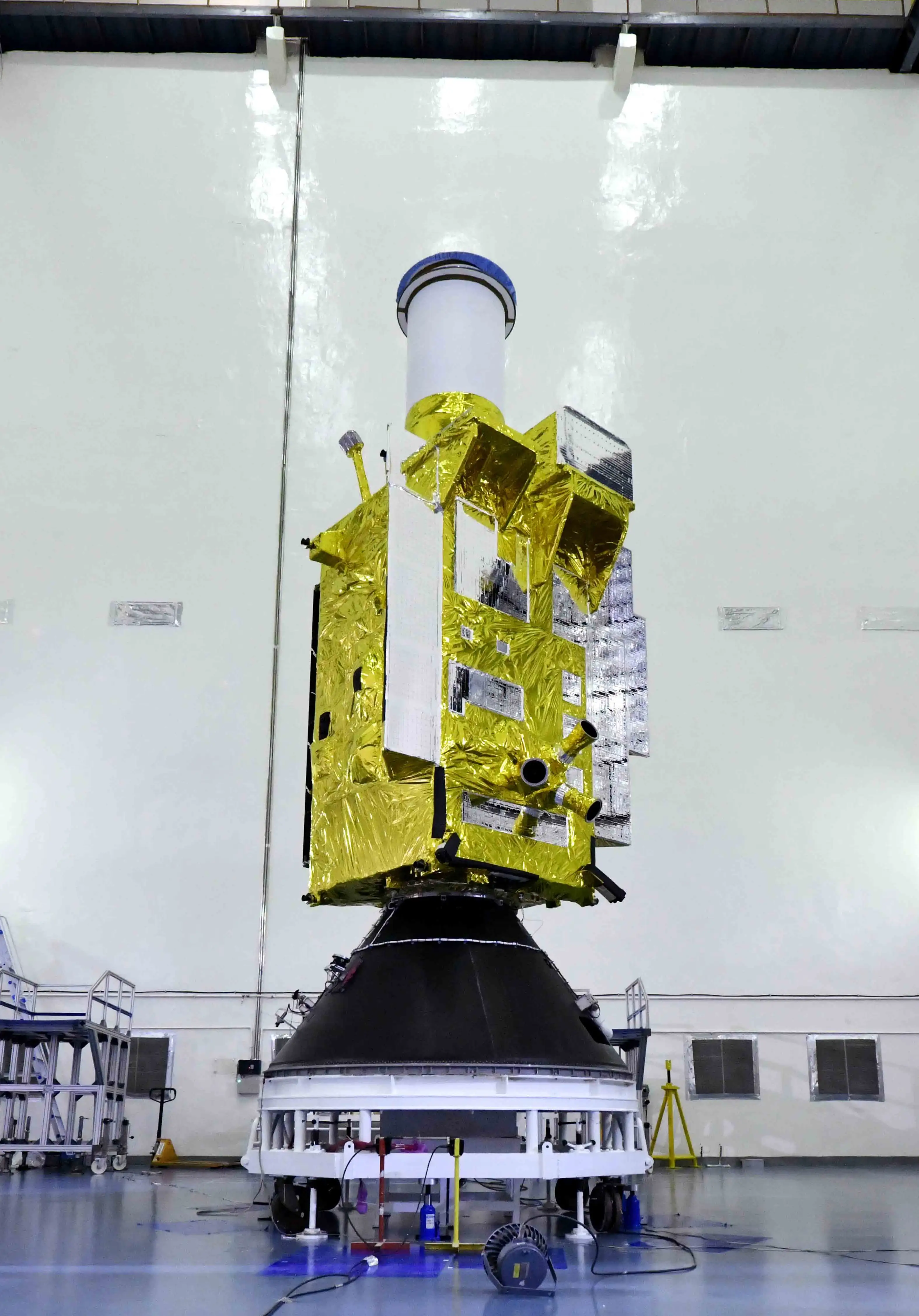
ISRO has now confirmed in writing that EOS-05 carries four imaging payloads, not three. The fourth is a six-band long-wave thermal infrared imager, and it was not on EOS-03, the GISAT-1 satellite lost in 2021.
In our September post we wrote that nobody outside ISRO knew what was inside EOS-05. We also said the instrument table everyone was reproducing, ours included, described a satellite that no longer existed. So on 15 September we filed an application under the RTI Act with ISRO Headquarters, asking sixteen specific questions about the spacecraft.
The reply from ISRO HQ's Central Public Information Officer is dated 30 October 2026. It answers more than we expected. It also overturns one thing we wrote, and it contains one number that does not fit ISRO's own published data.
We have published the complete reply, answer by answer with the original scanned letter, in the indianspaceflight.in RTI archive as ISF-RTI-2026-0006. Every figure below can be checked against it there.
Four payloads, not three
ISRO lists four payloads on EOS-05: MX-VNIR, HyS-VNIR, HyS-SWIR and MX-LWIR. These are ISRO's own figures for EOS-05 itself, not GISAT-1 numbers carried over.
Payload | Resolution | Swath | Bands | Range (µm) |
MX-VNIR (multispectral, visible and near infrared) | 42 m | 495 km | 6 | 0.45–0.875 |
HyS-VNIR (hyperspectral, visible and near infrared) | 320 m | 163 km | 158 | 0.4–0.87 |
HyS-SWIR (hyperspectral, shortwave infrared) | 191 m | 191 km | 256 | 1.0–2.50 |
MX-LWIR (multispectral, longwave infrared) | 1,180 m | 378 km | 6 | 7.1–13.5 |
Until now, the only detailed public figures were for GISAT-1, and they traced back to a 2016 NRSC presentation rather than any EOS-03 specification. The swath widths and the 1,180 m thermal resolution are, as far as we can find, published here for the first time. The MX-LWIR instrument itself, with six bands across 7.1–13.5 µm, was already listed in WMO's OSCAR database and a few exam-prep explainers, but not in any ISRO material we could find.
The hyperspectral count is unchanged at 414 channels. With the thermal bands, EOS-05 carries 426 bands in all.
How EOS-05 differs from EOS-03
EOS-05 is not EOS-03 rebuilt to the same drawing. It adds a thermal imager, weighs about 100 kg more, and is designed for a shorter life.
Parameter | EOS-03 (GISAT-1, 2021) | EOS-05 (GISAT-1A, 2026) |
Imaging payloads | 3: MX-VNIR, HyS-VNIR, HyS-SWIR | 4: adds MX-LWIR |
Thermal imaging | None | 6 bands, 7.1–13.5 µm, 1,180 m |
Lift-off mass | 2,268 kg | 2,367.1 kg |
Propellant | Not published | 1,128.4 kg |
Power | 2,280 W (2021 brochure, not stated as end of life) | About 2,000 W at end of life |
Design life | 10 years (2021 brochure) | 7 years |
Injection orbit | Standard GTO | Sub-GTO, 170 × 28,934 km at 19.28° |
Orbital slot | 85.5° E (planned) | 85.5° E |
HyS-VNIR | 318 m, 0.375–1.0 µm | 320 m, 0.4–0.87 µm |
HyS-SWIR | 191 m, 0.9–2.5 µm | 191 m, 1.0–2.50 µm |
The EOS-03 hyperspectral figures come from the 2016 NRSC presentation, not an EOS-03 specification. So the small differences in spectral range may reflect how the numbers were stated, not changed hardware.
The payload difference is stated directly. Asked whether EOS-05's payload differs from EOS-03's, ISRO answered that EOS-05 includes the Multispectral Longwave Infrared payload in addition to the EOS-03 payloads.
One public database disagrees. WMO OSCAR lists MX-LWIR on EOS-03 as well as EOS-05. ISRO is the primary source here, and the OSCAR entry looks like it reflects older programme plans. The same database places EOS-05 at 93.5° E, which ISRO's own orbit-raising update contradicts.
What the thermal channel changes
EOS-05 can image at night. That is the biggest practical change in the reply, and it reverses what we wrote in September.
A long-wave infrared imager senses heat the surface itself emits, so it does not need sunlight. ISRO's six bands span 7.1 to 13.5 µm, which covers the classic thermal window around 10 to 12 µm.
At 1,180 m, the useful jobs are land and sea surface temperature, cloud-top temperature, active fires and night-time cloud cover through the monsoon. WMO's instrument entry lists fire detection and surface temperatures as the primary objectives.
What it does not do is track individual targets. A 1.18 km pixel is far larger than any ship or vehicle, so this is area-level thermal watch. The cueing logic from our September post still applies: the wide sensor flags a change, and a low-orbit satellite takes the close look.
Against China, Gaofen-4's mid-wave infrared channel is 400 m, so EOS-05's thermal resolution is about three times coarser. But the line that India gets half a day of geostationary coverage and China gets all of it no longer holds.
One physics check. With a 700 mm aperture, the diffraction limit from geostationary distance is roughly 620 m at 10 µm and 840 m at 13.5 µm. A 1,180 m pixel sits comfortably above that, so it is consistent with the thermal channel sharing the main telescope. ISRO declined to confirm the aperture, so treat this as consistency, not proof.
The GISAT-2 question, reopened
The thermal channel makes the GISAT-1A versus GISAT-2 question harder, not easier.
Thermal was in the GISAT design from early on. Gunter's Space Page, citing a 2012 ISRO country report, lists a high-resolution multispectral LWIR imager at 1.5 km. Later descriptions moved LWIR to GISAT-2, which the Wikipedia programme page ties to a 2022 report that the Navy would acquire it for the Indian Ocean Region.
Now EOS-05 carries it. That leaves two readings. Either thermal was folded into the GISAT-1 replacement, or EOS-05 is closer to what was described as GISAT-2 than its GISAT-1A label suggests.
We asked ISRO directly whether EOS-05 is designated GISAT-1A or GISAT-2 in its records. The answer was that it is designated as EOS-05. That is accurate and settles nothing.
This next part is speculation. The roughly 100 kg mass increase now has a payload-side explanation, since cooled thermal detectors usually need a cryocooler and radiators. In September we called extra propellant the obvious explanation; we would now weigh both.
Swaths, mass, life and power
The rest of the reply fills in numbers that were either missing or circulating in conflicting versions.
Swaths. MX-VNIR covers 495 km, close to the 400 km field of view we assumed in September. The hyperspectral imagers cover only 163 km and 191 km. If those are frame widths and frames are roughly square, a hyperspectral frame covers 7 to 9 times less area than an MX-VNIR frame. So the 30-minute all-India figure, if it still holds, is almost certainly an MX-VNIR figure, and hyperspectral looks like a targeted mode. That is our inference; ISRO declined to share revisit requirements.
Mass. EOS-05 weighed 2,367.1 kg at lift-off, of which 1,128.4 kg was propellant. That puts the dry mass at about 1,239 kg. Public databases carry 1,000 kg dry for both GISATs, which looks like a placeholder.
Life. The designed mission life is seven years. That matches what Narayanan gave as the planned figure, though some launch-week reports carried ten years. The nine-plus years he mentioned after launch is a projection from the injection overperformance, not a design figure.
Power. End-of-life power generation is about 2,000 W. The 2,280 W in the 2021 EOS-03 brochure was not labelled end of life, so the two are not directly comparable.
One number that doesn't add up
The reply puts the total delta-v imparted to reach the final slot at 1,044.6 m/s. ISRO's own published burn data implies roughly 1.65 to 1.7 km/s.
The three planned manoeuvres match what ISRO reported in September, starting from an injection orbit of about 171 × 31,000 km:
Date (IST) | Manoeuvre | LAM firing | Orbit after |
5 Sept 2026, 20:19 | 5,406.4 s | 20,000 × 31,129 km | |
6 Sept 2026, 19:00 | 338.9 s | Apogee 35,786 km | |
7 Sept 2026, 20:57 | 1,247 s | 34,903 × 35,884 km |
Two independent checks give the same answer.
- Orbital mechanics. The velocity changes needed for those three orbits work out to about 1.18, 0.10 and 0.36 km/s, or 1.64 km/s in total. That is a floor, assuming no plane change at all.
- Burn times. The LAM fired for 6,992 s in total. At the nominal 440 N thrust, that is about 1.68 to 1.70 km/s, using roughly 1,000 kg of the 1,128.4 kg propellant load. The estimate depends mainly on thrust, not on specific impulse.
The two agree with each other and with the propellant figure. The RTI's 1,044.6 m/s is about 60% of both, and no single burn or pair of burns matches it either. It may be a typo or a figure measured on some different basis. A follow-up request for the delta-v of each manoeuvre should settle it.
A related point, clearly labelled as speculation. Removing the full 19.28° inclination would push the floor to roughly 1.84 km/s or more. The burn-time estimate sits below that, and ISRO's own updates describe the target as GSO, geosynchronous, rather than geostationary. EOS-05 may still carry significant inclination. Tracking data for NORAD 100607 should show it; we have not checked yet.
What ISRO declined to share
Five of our sixteen questions were refused or transferred, and one more was answered without saying anything. The refusals are informative in themselves.
- Optics and detectors. The telescope aperture, optical configuration, focal ratio, detector type, array format and pixel pitch were all withheld as classified design specifications. So the 700 mm Ritchey-Chretien figure, and the diffraction and jitter arithmetic in our September post, remain unconfirmed for EOS-05.
- Revisit. The designed revisit intervals were withheld because the mission requirements are classified. The five-minute and 30-minute figures come from GISAT-1-era material and are not confirmed for EOS-05.
- Designation. The answer to whether EOS-05 is GISAT-1A or GISAT-2 was only that it is designated as EOS-05.
- Data policy and the 2016 presentation. Our questions on data availability through NRSC and Bhoonidhi, and on the 2016 NRSC presentation, were transferred to NRSC. Their reply is pending.
GISAT-1's revisit targets were in ISRO's own public material. Treating the same requirements as classified for a satellite described as civilian is worth noting.
Corrections to our September post
Three statements in the earlier post were wrong or out of date, and two need qualifying.
- Wrong: "GISAT-1A carries no thermal band, which makes it a daylight instrument." EOS-05 carries a six-band LWIR imager.
- Wrong: that India's geostationary thermal capability was deferred to GISAT-2, leaving India half a day of coverage. EOS-05 provides it now, at 1,180 m.
- Out of date: "ISRO has not said publicly where EOS-05 is going." ISRO named the 85.5° E slot in its 5 September orbit-raising update, and the RTI reply confirms it.
- Qualified: that the headline number is 414 spectral channels. Still true for the hyperspectral imagers; the total is now 426 bands.
- Qualified: the instrument table and its caveat. It is replaced by ISRO's own EOS-05 figures above.
What to watch next
The RTI settles what EOS-05 carries. Whether that capability works, and who gets the data, is still open.
- First images. A thermal scene would be the first public proof that the LWIR channel works in orbit.
- NRSC's reply. It should say which data products reach Bhoonidhi, and when.
- The delta-v figure. A per-manoeuvre breakdown would show whether 1,044.6 m/s is an error or a different measure.
- Inclination. Tracking data will show whether EOS-05 is geostationary or still inclined.
- GISAT-2. Whether a separate Navy satellite is still planned, now that EOS-05 already carries thermal.
Sources
The RTI reply
- ISRO HQ, Central Public Information Officer, reply No. ISRO HQ: CPIO: RTI: 2026/T00130, 30 October 2026. It encloses the custodian of records' input No. ISRO HQ:RTI:ISROH/R/T/26/00130, 22 October 2026.
- Full reply and scanned letter: indianspaceflight.in RTI archive, ISF-RTI-2026-0006
ISRO
- GSLV-F17/EOS-05 Mission page
- First orbit manoeuvre of EOS-05, 5 September 2026
- Second orbit manoeuvre of EOS-05, 6 September 2026
- ETV Bharat, quoting ISRO's release on the third manoeuvre, 8 September 2026
Databases
- WMO OSCAR, EOS 05 (GISAT-1A)
- WMO OSCAR, EOS 03 (GISAT-1)
- WMO OSCAR, MX-LWIR instrument
- Gunter's Space Page, GISAT 1, 1A (EOS 03, 05)
- Wikipedia, GEO Imaging Satellite
Coverage
- The Space Review, Ajey Lele, ISRO's comeback with the successful launch of EOS-05, 8 September 2026
- Deccan Chronicle, EOS-05 completes first orbit-raising manoeuvre, September 2026
- UNI, countdown report for GSLV-F17/EOS-05, 3 September 2026
- Our earlier post: ISRO EOS-05 / GISAT-1A Explained: The Eye That Never Blinks, September 2026