
ISRO April 2026 RTI Update: FAC Findings on GSAT-6A Failure, NVS-02 Status, and NavIC Health
ISRO April 2026 RTI Update: FAC Findings on GSAT-6A Failure, NVS-02 Status, and NavIC Health
RTI application, filed on January 17, 2026, sought technical clarifications regarding multiple ISRO mission anomalies and the current operational status of the NavIC constellation. The request was officially processed and disposed of on April 10, 2026, providing specific root cause analyses for past failures. A major highlight of this disclosure is the technical update on the GSAT-6A mission, where the Failure Analysis Committee (FAC) determined that the loss of communication was caused by arcing in the harness, which deprived all critical systems of power. Crucially, ISRO identified that this arcing was likely triggered by a Micrometeoroid and Orbital Debris (MMOD) hit, providing a definitive external cause for the power bus failure.
Additionally, the response clarified that the NVS-02 orbit injection anomaly was caused by a pyro valve malfunction that prevented oxidizer from reaching the Liquid Apogee Motor (LAM). The disclosure also provides a transparent health check of the NavIC fleet, confirming only three satellites are currently fully functional for PNT services, and details the strategic decision to apply PS3 motor improvements across both the PSLV and SSLV programs to ensure future launch reliability. For more detail and exact answers, read below:
- Question: (a) Please provide the specific technical reason (root cause) identified by the Failure Analysis Committee (FAC) for the non-initiation of the vertical jettisoning system of the heat shield.
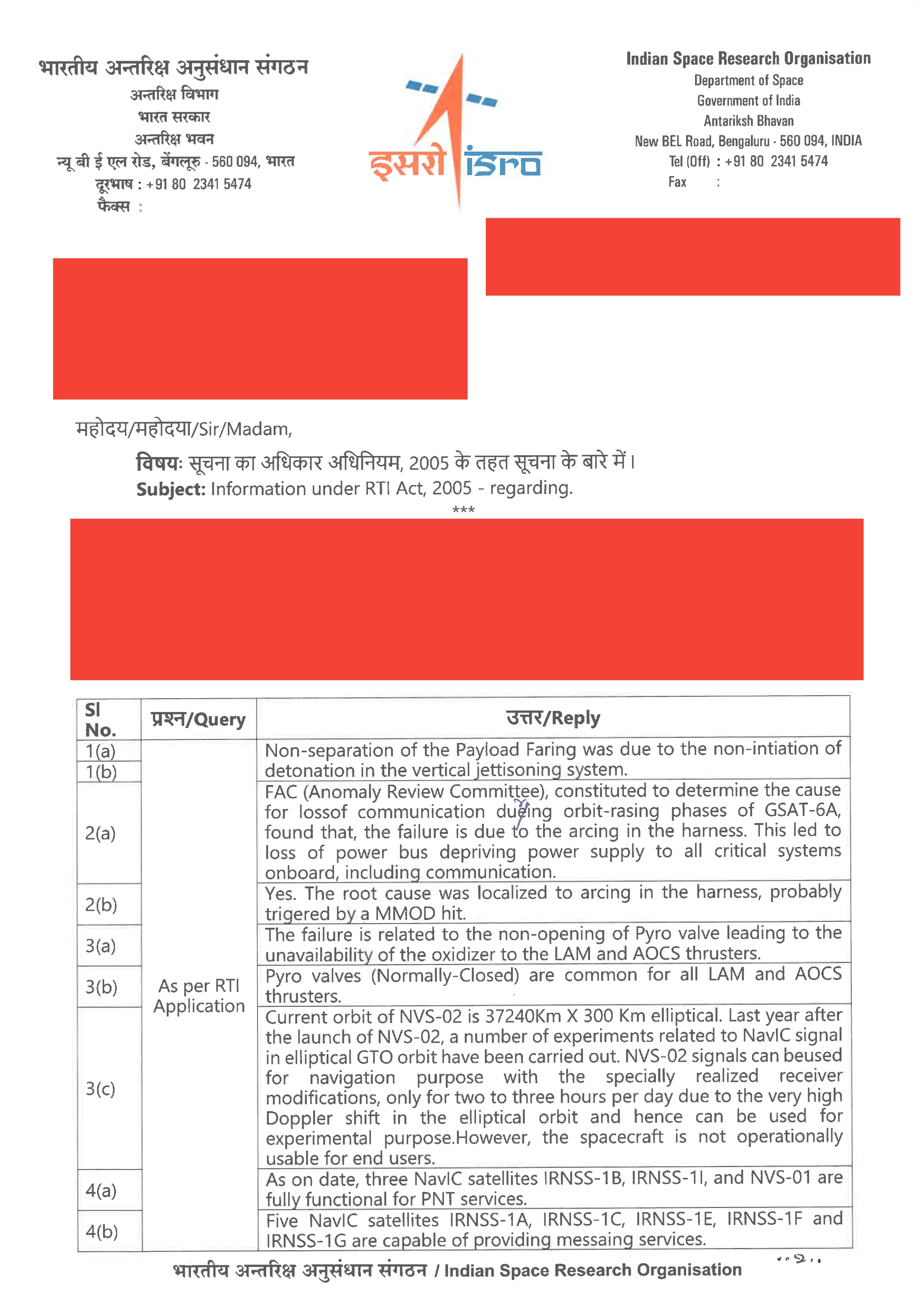
- Answer: Non-separation of the Payload Fairing was due to the non-initiation of detonation in the vertical jettisoning system.
Regarding GSAT-6A Mission:
- Question: (a) Please provide the findings of the FAC regarding the loss of communication during the orbit-raising phase. (b) Was the root cause identified as a power system anomaly, and if so, specifically which component was responsible?
- Answer: FAC found that the failure is due to the arcing in the harness.This led to loss of power bus depriving power supply to all critical systems onboard, including communication.The root cause was localized to arcing in the harness, probably triggered by a MMOD hit.
Regarding NVS-02 Mission:
- Question: (a) Please state the technical cause for the anomaly encountered during the orbit-raising maneuvers. (b) Specifically, was the failure related to the non-opening of the oxidizer valve in the LAM or a different propulsion system component? (c) What is the current orbital status of NVS-02, and is the payload being used for any experimental or operational purpose?
- Answer: The failure is related to the non-opening of Pyro valve leading to the unavailability of the oxidizer to the LAM and AOCS thrusters.Pyro valves (Normally-Closed) are common for all LAM and AOCS thrusters.Current orbit is 37240Km X 300 Km elliptical.NVS-02 can be used for experimental purpose (2-3 hours per day) but is not operationally usable for end users.
Regarding NavIC (IRNSS) Constellation Status:
- Question: (a) How many NavIC satellites are fully operational for PNT services? (b) How many are providing only messaging services? (c) Please list the specific Satellite IDs that are non-operational or partially operational.
- Answer: As on date, three satellites (IRNSS-1B, IRNSS-1I, and NVS-01) are fully functional for PNT services.Five satellites (IRNSS-1A, 1C, 1E, 1F, and 1G) provide messaging services.IRNSS-1D is decommissioned; IRNSS-1H and NVS-02 could not reach the intended orbit.
Regarding PSLV-C61 Investigation and PS3 Stage:
- Question: (a) & (b) Has the FAC report for PSLV-C61 been finalized and what is the root cause? (c) Was the PS3 stage static-test fired subsequent to the investigation? (d) Which authority is responsible for the decision to release or withhold FAC reports?
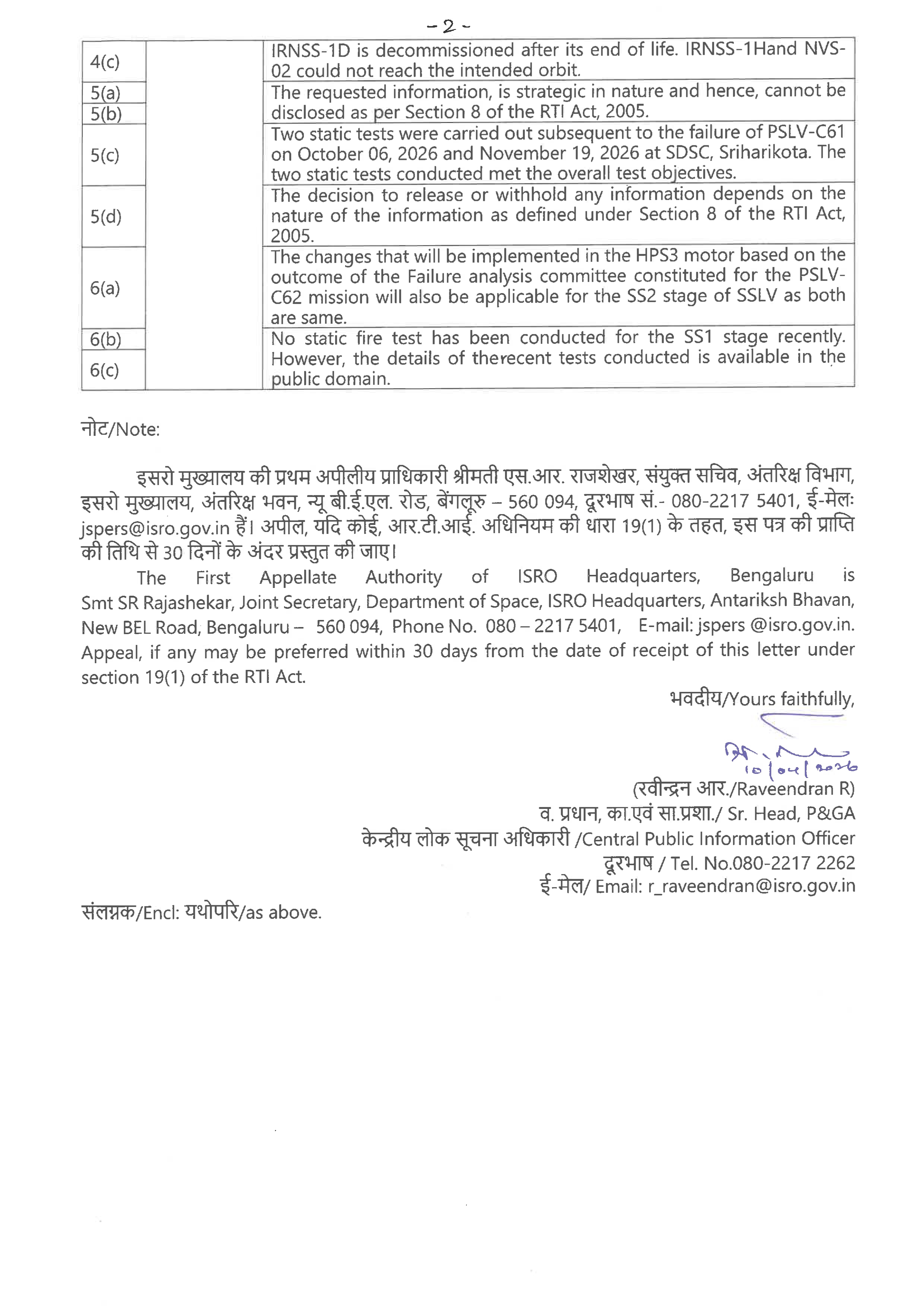
- Answer: The requested information is strategic in nature and cannot be disclosed as per Section 8 of the RTI Act.Two static tests were carried out subsequent to the failure (Oct 06, 2026, and Nov 19, 2026) and met overall objectives.The decision to withhold information depends on its nature as defined under Section 8 of the RTI Act.
Regarding SSLV and Solid Motor Correlations:
- Question: (a) Do findings regarding the PS3 anomaly have technical implications for the SSLV Stage 2 (SS2)? (b) & (c) Outcome of the recent SSLV SS1 static fire test and findings regarding nozzle integrity or oscillation issues.
- Answer: Changes implemented in the HPS3 motor based on the PSLV-C62 FAC will also be applicable for the SS2 stage of SSLV as both are same.No static fire test has been conducted for the SS1 stage recently; details of recent tests are available in the public domain.