The NavIC Illusion: How Broken Clocks and Bureaucratic Denial Left India’s Navigation System Functionally Defunct
blog
296
Operating a satellite navigation constellation is one of the most unforgiving technical challenges in modern spaceflight. As the Indian Space Research Organisation (ISRO) navigates the complex transition from its first-generation Navigation with Indian Constellation (NavIC) satellites to the next, recent orbital events highlight a fundamental reality of the industry: space hardware fails. However, what separates a robust space program from a vulnerable one is how swiftly its leadership anticipates and mitigates those inevitable anomalies.
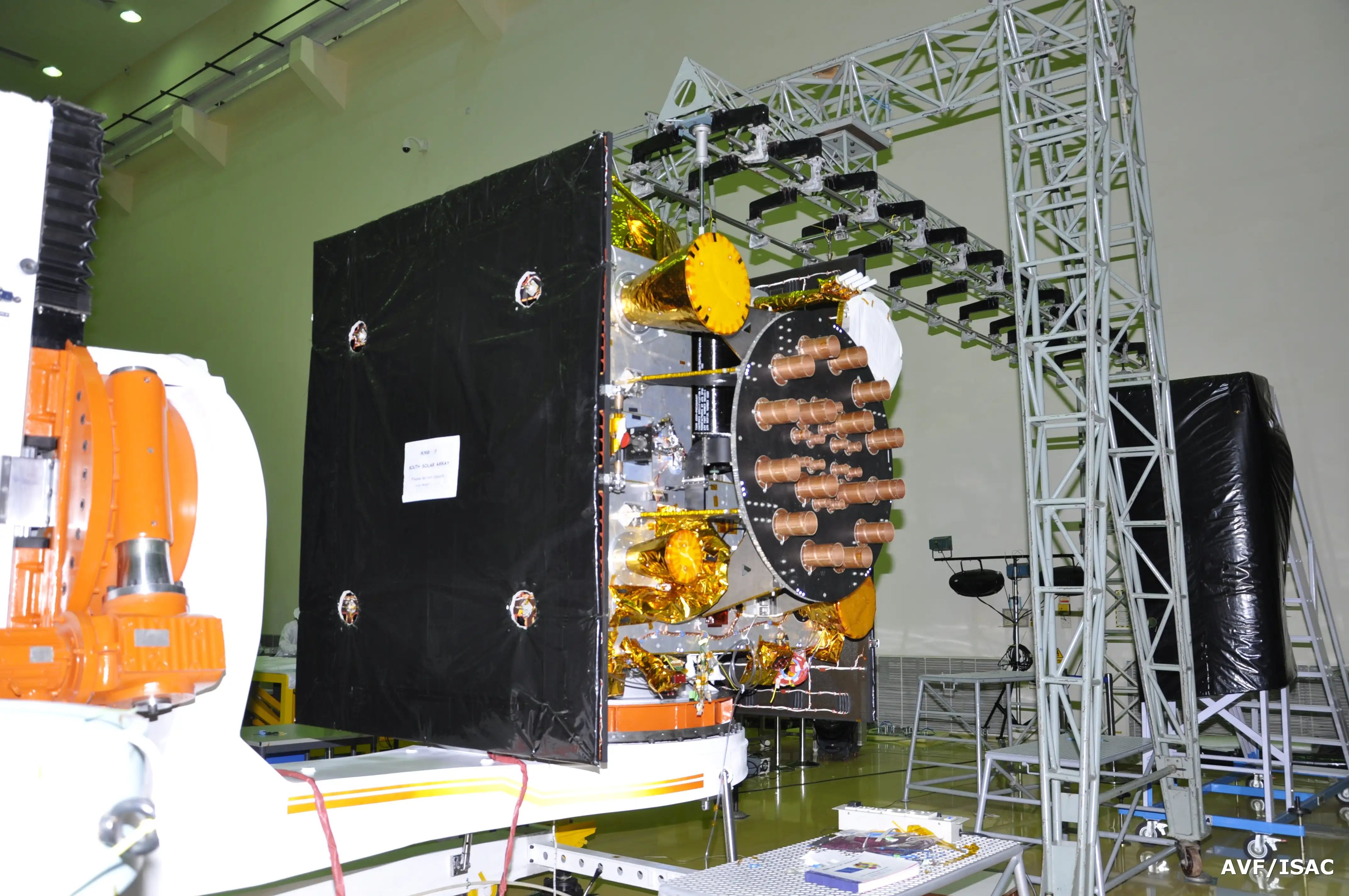
IRNSS-1F in the clean room during its integration. Image credit: ISROThe recent announcement on March 13, 2026, regarding the IRNSS-1F satellite brings this reality into sharp focus. Having launched in March 2016, the spacecraft reached its 10-year design mission life. Yet, on that exact anniversary, the satellite's final procured on-board atomic clock stopped functioning. While the spacecraft remains in orbit and has been repurposed to provide one-way broadcast messaging services, the loss of its timing hardware means it can no longer provide active Position, Navigation, and Timing (PNT) services.
This development places the regional NavIC network in a highly constrained, borderline critical operational state. To understand why this is an emergency, one must look at the strict mathematics of how satellite navigation actually works. Navigation satellites do not track your phone or vehicle. Instead, they constantly broadcast highly precise, time-stamped signals. Your receiver calculates the time it took for each signal to arrive to determine the exact distance to each satellite. A single satellite narrows your location down to a massive sphere. Two intersecting spheres create a circular ring of possible locations. Three satellites intersect to pinpoint exactly two possible points, providing a basic 2D position consisting of latitude and longitude.
However, your receiver's internal clock is nowhere near as accurate as the multi-million dollar atomic clocks on the satellites. Therefore, a strict minimum of four functional satellites is mathematically required to solve for receiver clock errors and calculate a true 3D position, which includes altitude. To ensure consistent, high-precision coverage without blind spots across India's vast and difficult terrain, a regional system ideally needs seven active satellites.
With IRNSS-1F's PNT services offline, and following the propulsion failure of the NVS-02 replacement satellite in early 2025, the constellation's buffer is completely non-existent. Currently, only IRNSS-1B, IRNSS-1I, and NVS-01 are fully operational for navigation. You simply cannot run an independent national defense and civilian navigation grid on three satellites.
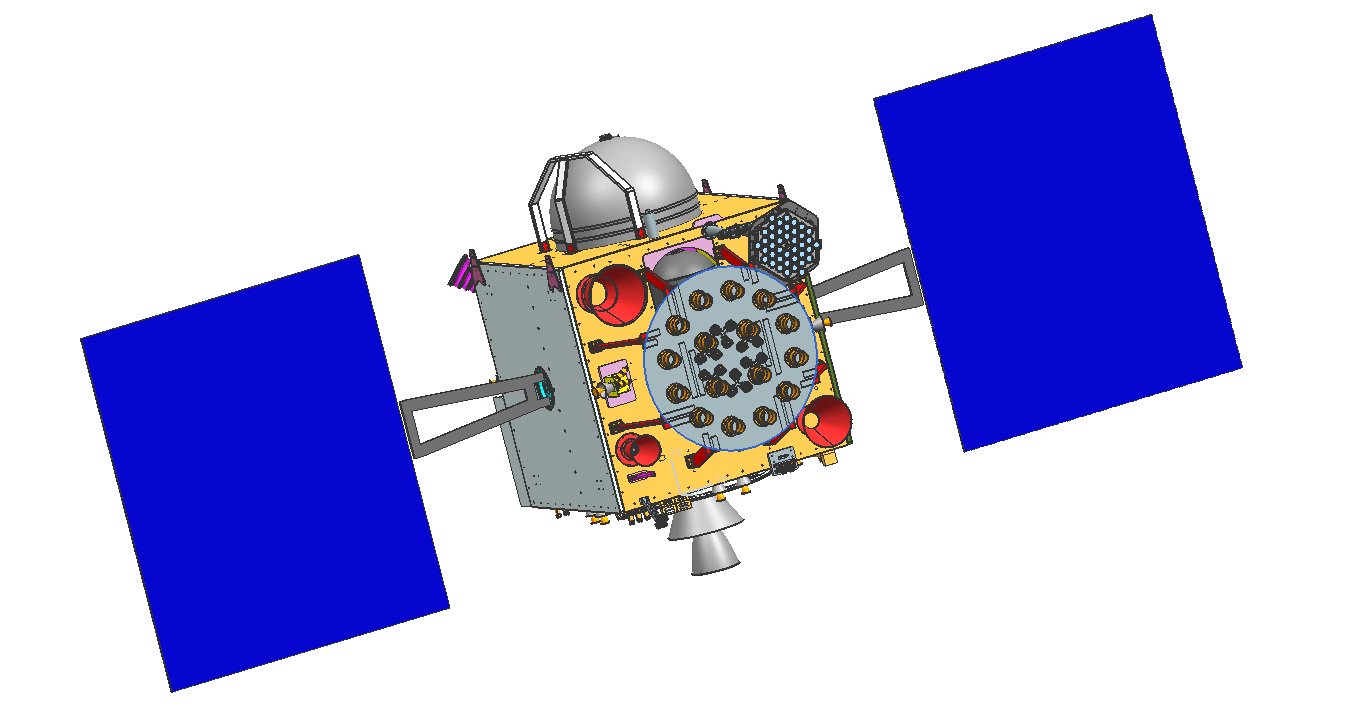
Rendering of typical Indian Regional Navigation Satellite System (IRNSS) series one spacecraft for Navigation with Indian Constellation (NavIC)To understand the attrition rate of NavIC’s first-generation atomic clocks, one must look beyond India’s borders to recognize that this was not an ISRO engineering failure, but a global supply chain crisis. Five other NavIC satellites have previously experienced the complete failure of all three of their onboard atomic clocks. The Rubidium Atomic Frequency Standard (RAFS) clocks used in these early satellites were manufactured by SpectraTime, a Swiss subsidiary of the Orolia Group. This is the exact same manufacturer that supplied the European Space Agency for its Galileo constellation, which faced a massive crisis in early 2017 when nine clocks failed in rapid succession due to probable short circuits and ground-testing fatigue. The failure of the SpectraTime RAFS units was an industry-wide headache, not a localized oversight by Indian scientists.
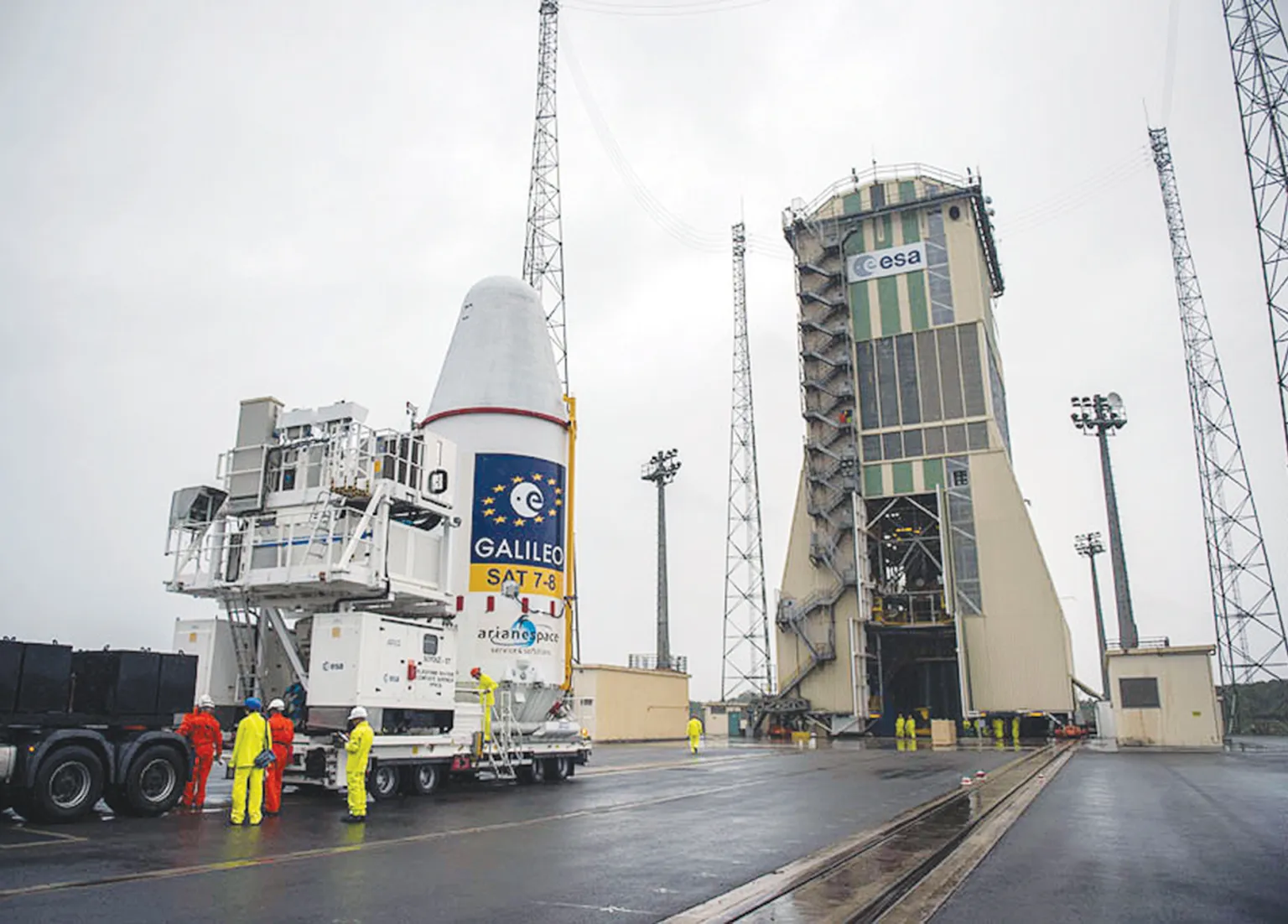
Galileo 7 and Galileo 8 being moved to the launch pad in 2015. Credit: ESA-CNES-ARIANESPACE/Optique Vidéo du CSGHowever, while the failure of the hardware was an imported crisis, the institutional response was a domestic failure. This is where ISRO’s leadership and government policymakers must face rigorous questioning. The European Space Agency immediately recognized the threat to Galileo in 2017 and mobilized an aggressive mitigation and replacement strategy. In contrast, why did India's leadership allow NavIC to slowly degrade without an urgent, fast-tracked contingency plan? Once the vulnerability of the SpectraTime clocks became an undeniable reality, there should have been an immediate pivot to accelerate the development and launch of replacement satellites. Instead, the system was allowed to bleed out until it dropped below the critical operational threshold.
Furthermore, the government's aggressive push to mandate NavIC compatibility in commercial vehicles and consumer smartphones appears alarmingly disconnected from the reality in orbit. Pushing regulatory mandates for a navigation system hanging by the thread of three operational satellites is not just premature; it risks severely eroding commercial and public trust in indigenous technology. Why were these mandates enforced while internal Root Cause Analyses for the atomic clock failures were simultaneously being classified under the RTI Act, shielding procurement decisions from public scrutiny? A nation cannot claim strategic navigational autonomy while its system is entirely vulnerable to a single point of failure and lacking a robust Plan B.
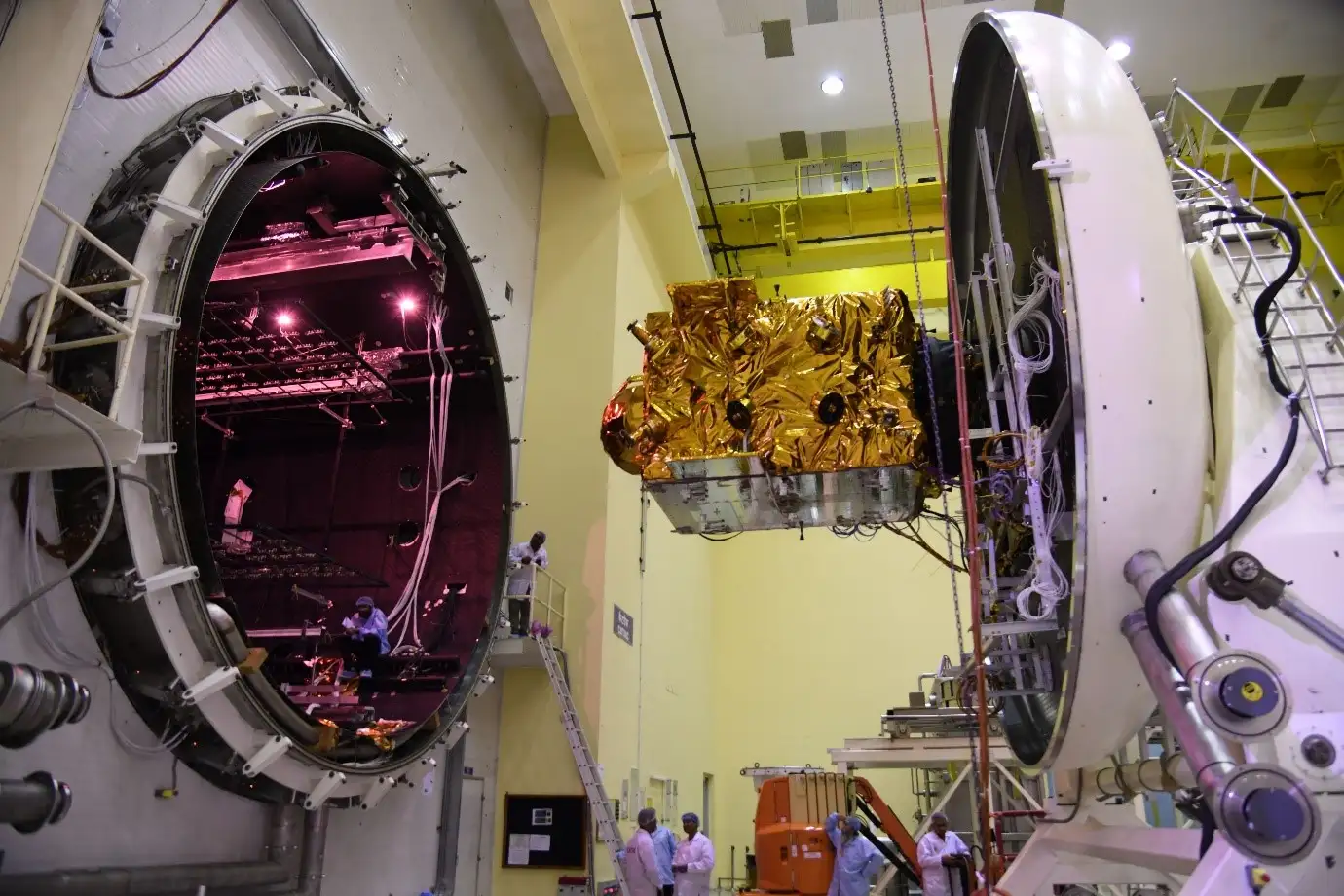
NVS-02 loading to Comprehensive Assembly and Test Thermo-Vacuum chamber (CATVAC) for thermovac Test Image credit: ISROCompounding NavIC’s transition period was the anomaly during the NVS-02 mission in January 2025. A thorough Apex Committee investigation revealed a frustratingly simple mechanical root cause: the disengagement of electrical contacts in both the primary and redundant paths of the pyro-valve connector, preventing main engine ignition. While it is true that the aerospace industry thrives on iterative learning, and ISRO admirably implemented redundancy recommendations for the subsequent CMS-03 mission, the fact that a single disconnected wire could effectively cripple India's navigation buffer highlights a severe lack of redundancy in the broader constellation architecture.
Despite the current bureaucratic and operational bottlenecks, the roadmap for India's navigational independence remains deeply promising. The immediate priority is stabilizing the base layer with the upcoming launches of NVS-03, NVS-04, and NVS-05. These new units will utilize indigenous atomic clock technology to finally break the reliance on vulnerable foreign hardware. More importantly, ISRO is actively laying the groundwork for the Global Indian Navigation System (GINS). By awaiting approval for a massive expansion to place 12 satellites into Medium Earth Orbit, NavIC plans to drastically expand its operational footprint from 1,500 kilometers beyond India's borders to 3,000 kilometers, ultimately aiming for a 30-satellite global network.
National Space Day Meet, Nilesh M desai [22 August 2025] (r/ISRO)
National Space Day Meet, Nilesh M desai [22 August 2025] (r/ISRO)
The current state of the NavIC constellation is a crucible for India's space ambitions. Hardware failures and orbital anomalies are unavoidable realities of exploring the void, and ISRO's engineers deserve defense for navigating imported hardware flaws. But building a truly robust, global space infrastructure requires more than just good engineering. It requires transparent leadership, aggressive contingency planning, and the willingness to acknowledge operational vulnerabilities before they become national crises.

![National Space Day Meet, Nilesh M desai [22 August 2025] (r/ISRO)](https://firebasestorage.googleapis.com/v0/b/indianspaceflight-v2.firebasestorage.app/o/media%2Feditor-media%2Finline-images%2FtMkLEwA8I3RWfVqlJfvZNoBudak2-1773468108164-w3yssk.jpeg?alt=media&token=a9a4f5d8-8ecc-4918-a360-5e43afa5827f)
![National Space Day Meet, Nilesh M desai [22 August 2025] (r/ISRO)](https://firebasestorage.googleapis.com/v0/b/indianspaceflight-v2.firebasestorage.app/o/media%2Feditor-media%2Finline-images%2FtMkLEwA8I3RWfVqlJfvZNoBudak2-1773468121096-ydz49e.jpeg?alt=media&token=6b6794a5-6602-4a26-aadc-6c22c105ae7a)